
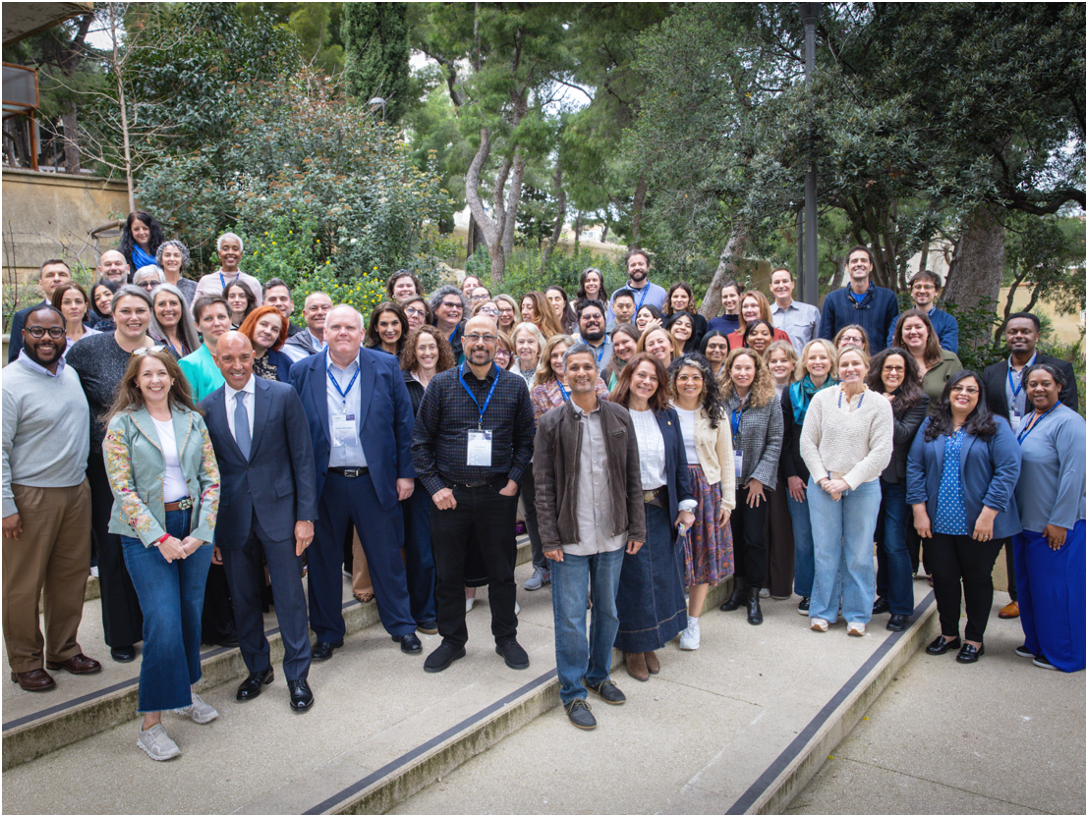
2026 is the International Year of Volunteering, declared by the UN, 25 years after the first one in 2001. Between these two milestones, a lot has changed: wars, a pandemic, new technologies, new ways of working — and volunteering has become a strategic tool for companies, governments and communities.
Atados attended the Points of Light Network global gathering in Marseille, and this content brings together the main learnings shaping the future of volunteering in Brazil and around the world.
“Volunteering changes everything.”
Points of Light's vision of volunteering's impact in the world
01 • Global Perspective
Volunteering has changed — and keeps changing everything
Between 2001 and 2026 the global social landscape has transformed. Conflicts, climate change, political polarization and new technologies have redefined the social problemswe face — and, with them, the causes that mobilize people: hunger, education, mental health, equity, inclusion.
The view that volunteering changes everything is rooted in the perception that social change can only happen with an engaged society — and for that, volunteering must be positioned as the great transformative agent.
02 • Impact on NGOs
Sustainability and ability to scale
03 • Impact on volunteers
Career, learning and mental health
Volunteering transforms those who participate. The effects range from employability to longevity — and that changes how companies think about developing their teams.
04 • Impact on companies
Engagement, connection and professional development
83%
of managers say companies should act on important social issues. [9]
70%
of managers say volunteering improves the work climate more than happy hour. [10]
66%
of Fortune 500 companies offer paid time for volunteering. [11]
78%
of volunteers say the practice develops leadership and decision-making skills. [12]
49%
of managers say volunteering with colleagues strengthened their work relationships. [13]
US$ 1.3 tri
is the estimated value generated by volunteer work worldwide. [14]
05 • International inspiration
Cases that show volunteering transforming cultures
🇮🇳 India — Immersive programs
Long-term methodologies that use volunteering to strengthen inclusive communities. Volunteering as a process, not as an event.
🇺🇦 Ukraine — Volunteering is resistance
Almost 100% of the population volunteers. Significant growth of informal volunteering and the development of methodologies to scale in times of crisis.
🇺🇸 US — A tool for resilient communities
In a context of polarization and uncertainty, volunteering proved effective at reducing polarization and making people feel part of the solution.
06 • Culture
A volunteering culture depends on perceived value
One of the main conclusions from the conference: companies that sustain consistent volunteering programs are those that see real value in it — regardless of the political, ideological or economic scenario.
Key concept
BELONGING
“Pertencimento.”
More than donating time, corporate volunteering generates belonging — among employees, with the community and with the company's purpose.
07 • Volunteering as a tool
More than doing good
Nine dimensions in which corporate volunteering ceases to be a CSR action and becomes a strategic tool for people, companies and society.
People & culture
Mental health and
wellbeing
- Tackling the loneliness epidemic: 39% of people live within the loneliness epidemic.
- Generates a sense of purpose: which reduces burnout.
Inclusion and belonging
(it's not diversity, but it is part of the diversity strategy)
- Connection strategy with affinity groups through volunteering: positions volunteering as a means of including diverse groups in the company and connecting people.
A bridging tool
- Between companies: joint program development across companies.
- Between teams: an HR strategy to consolidate relationships among employees.
Engagement & strategy
Engagement as cause and goal
- Volunteering boosts engagement: volunteers tend to participate more in other initiatives proposed by the company.
- Increases retention and productivity: the volunteer sees the company as the enabler of their social action, which increases retention.
Connection with social strategy
- Connects ESG strategy and materiality: linked to the company's social purpose.
- Materializes the company's purpose and values: through employees' participation in actions that are part of the social strategy.
Methodology
- Robust methodologies consolidate strategy: when the volunteering program is strategic, companies enable end-to-end processes that increase engagement and impact and connect volunteering with the business.
Brand & business impact
Positioning
- Real marketing: beyond communication campaigns, real impact and connection between companies and customers through their social purpose and values.
Resilience
- In times of image crisis: companies with consolidated volunteering programs have higher employee engagement and stronger purpose connection, helping them weather external image crises.
Scale
- Scale x quality: companies' main challenge has been scaling the program while making it increasingly strategic and aligned with their social action.
08 • Brazilian National Volunteering Strategy
Atados created the Brazilian National Volunteering Strategy
2026 is the International Year of Volunteering for Sustainable Development — a designation by the UN General Assembly. As a response, Atados is building a network to double the number of volunteers in Brazil by 2035, connecting leaders of social transformation who amplify their work through volunteering.
A simple and accessible path
So that everyone can connect, act with intention and strengthen the network that transforms. Inspired by success stories, we developed three pillars that structure this journey:
- Why every institution is essential to expanding the volunteering culture.
- The direct impact volunteering generates in your daily life.
- How each one can contribute concretely to the plan.
References
Data sources
- [1]Philanthropy Roundtable — Statistics on U.S. Generosity
- [2]Do Good Institute — The State of Volunteer Engagement (2023)
- [3]Fidelity Charitable — Volunteering and Philanthropy
- [4]Points of Light — From Nice to Necessary: Unleashing the Impact of Volunteering Through Transformative Investment
- [5]AmeriCorps — Volunteering as a Pathway to Employment
- [6]Okun, M. A., et al. — Volunteering by Older Adults and Risk of Mortality: A Meta-Analysis
- [7]BISC Research — survey with managers responsible for volunteering programs
- [8]Latham, M. — Young Volunteers: The Benefits of Community Service
- [9]PwC — Global Hopes & Fears Survey 2023
- [10]Deloitte — Workplace Volunteer Opportunities Survey
- [11]Double the Donation — Corporate Giving and Matching Gift Statistics
- [12]Deloitte — Workplace Volunteer Opportunities Survey
- [13]Deloitte — Workplace Volunteer Opportunities Survey
- [14]UN Volunteers — State of the World's Volunteerism Report 2026
Connect with Atados
Want to turn your company's volunteering into a strategy for impact?
We bring to Brazil the global methodologies and trends redefining corporate volunteering. Let's talk?